



























































Software Testing Strategies for building digital products that don’t break when real users show up

Introduction
A few years ago, a startup I worked with was confident about their product launch. Everything looked perfect in staging. The UI was smooth, the features were complete, and the demo went without a single issue.
Then real users arrived.
Within minutes, dashboards froze, payments failed intermittently, and error logs started flooding in. The problem was not a lack of development effort. The problem was weak thinking around Software Testing Strategies.
That moment is something many teams experience at least once. It is usually the point where testing stops being “a phase” and starts becoming a survival tool.
In modern product development, Software Testing Strategies are not just about finding bugs. They are about predicting how software behaves when real life stops being predictable.
When good code is not enough
Every developer has been here. The code works locally. It passes basic checks. It even looks clean in reviews.
But software does not live in isolation.
It lives inside unpredictable environments, unstable networks, different devices, and impatient users. This is exactly where Software Testing Strategies start separating reliable products from fragile ones.
Good engineering is not just about writing code that works. It is about designing confidence into that code before it ever reaches users.
The shift from testing at the end to testing all the time
Older development cycles treated testing like a final gate. Build everything, then test at the end. That approach rarely survives modern release speed.
Today, teams embed Software Testing Strategies directly into development. Testing begins when requirements are written, not when development is finished.
In agile teams, every sprint becomes a mini release cycle. That means every feature is constantly under validation. The mindset shift is simple but powerful. Testing is not an event anymore. It is a continuous habit.
This is where quality starts becoming predictable instead of accidental.

The reality behind real-world failures
Most production failures are not dramatic edge cases. They are simple things that were overlooked under pressure.
A timeout that was never tested under load.
A form that breaks on slower devices.
An API call that behaves differently under stress.
These issues are exactly why Software Testing Strategies matter so much. They force teams to think beyond “does it work” and ask “how does it fail.”
Because in real systems, everything eventually fails. The only question is how gracefully.
Why automation changed everything
There was a time when testing meant long hours of repetitive manual checks. It worked, but it did not scale.
Automation changed that completely.
Modern Software Testing Strategies rely heavily on automated testing because speed and consistency matter more than ever. Tools like Selenium, Cypress, and Playwright allow teams to run thousands of checks in minutes instead of days.
But automation is not just about speed. It is about discipline. It forces teams to define expected behavior clearly and consistently.
And once that discipline is in place, quality becomes less dependent on individuals and more dependent on systems.
The hidden value of a strong testing framework
A good testing framework is rarely visible to users, but it quietly protects everything they experience.
It decides how unit tests, integration tests, and system tests work together. It defines what gets checked early and what gets validated later.
Well-designed Software Testing Strategies turn this framework into something scalable instead of fragile.
Without that structure, testing becomes random. With it, testing becomes predictable, repeatable, and reliable even as the product grows.
CI/CD is where testing meets reality
Continuous integration and deployment changed the rhythm of software delivery.
Instead of waiting for scheduled releases, teams now push changes constantly. That speed is powerful, but it also increases risk.
This is where Software Testing Strategies become essential again. Every commit triggers automated validation. Every change is checked before it reaches production.
It creates a safety net that runs silently in the background, catching problems before users ever see them.
And over time, that safety net becomes one of the most valuable parts of the entire system.
The uncomfortable truth about test coverage
No matter how mature a team becomes, test coverage is never perfect.
There are always edge cases nobody thought of. Always user behaviors that feel “unlikely” until they happen.
Strong Software Testing Strategies do not try to eliminate uncertainty completely. Instead, they focus on reducing blind spots in the most critical areas.
It is not about testing everything. It is about testing what matters most when things go wrong.
When environments lie to you
One of the most frustrating moments in testing is when everything passes in staging but fails in production.
This usually happens because environments are not truly aligned.
Real-world systems behave differently under real data, real traffic, and real timing conditions. That gap is why Software Testing Strategies always emphasize environment parity.
The closer testing environments are to production, the fewer surprises appear later.
Advanced testing is no longer optional
As systems grow, basic functional testing is not enough.
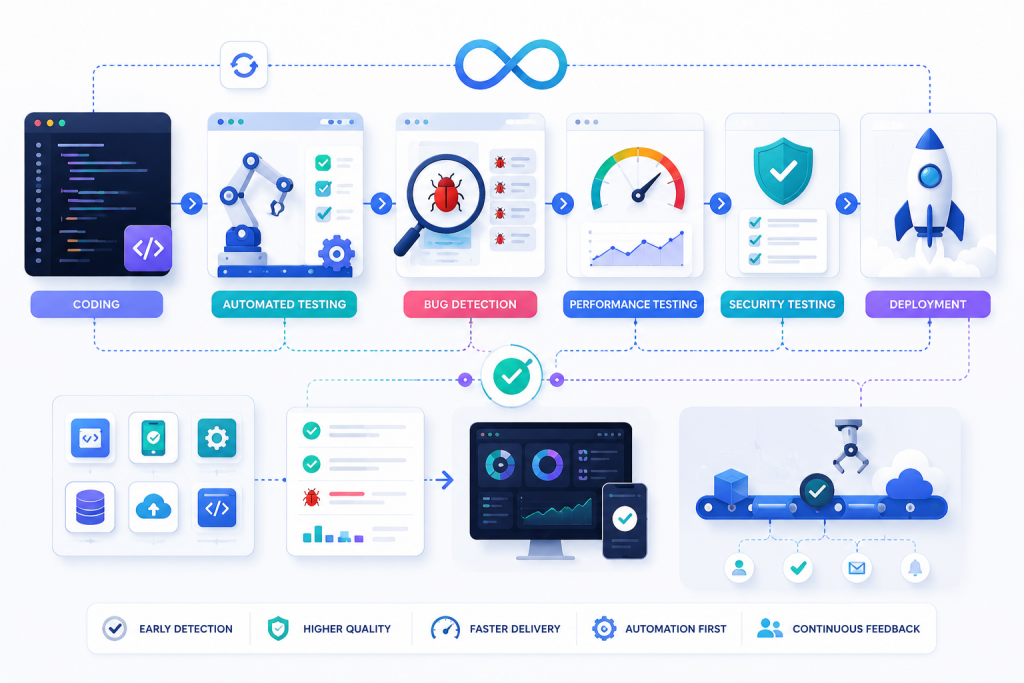
Modern applications require performance validation, security checks, API reliability testing, and usability evaluation. These are not “extra” anymore. They are core expectations.
Strong Software Testing Strategies integrate all of these layers so that quality is not measured from one angle but from multiple perspectives.
Because real users do not care whether something passed a unit test. They care whether it works smoothly, safely, and consistently.
What strong testing actually gives a team
When teams adopt mature testing practices, something interesting happens.
Deployments become less stressful. Bugs become less surprising. Releases become more predictable.
Software Testing Strategies reduce the emotional load of shipping software. Instead of hoping things work, teams start knowing they will work.
That shift in confidence is often more valuable than any single tool or framework.
A simple way to think about it
If development is about building features, testing is about building trust.
And Software Testing Strategies are what turn that trust into something repeatable.
They do not just protect code. They protect users, reputation, and long-term product survival.
FAQ
What are Software Testing Strategies really about
They are structured approaches that help teams decide how to test software effectively across different stages of development.
Why do they matter so much in modern development
Because modern systems are complex, fast-moving, and interconnected. Without strong strategies, failures become unpredictable.
Are automated tests enough on their own
No. Automation is powerful, but it works best when combined with thoughtful planning and exploratory testing.
What is the biggest mistake teams make
Treating testing as a final step instead of integrating it throughout development.
Conclusion
Most software does not fail because teams do not care about quality. It fails because quality is assumed instead of engineered.
Software Testing Strategies bring structure to that uncertainty. They turn testing from a last-minute check into a continuous system of confidence.
And in modern development, that confidence is what keeps products alive when real users arriv