




























































JSON is one of the most important data formats used in modern software development. From web applications and APIs to mobile apps and cloud services, JSON enables systems to exchange information quickly and efficiently. Because of its simplicity and readability, developers across the world rely on it for storing and transmitting structured data.
One of the most fundamental concepts in JSON is the use of arrays. Understanding JSON syntax square brackets helps developers organize collections of information in a way that is easy for both humans and machines to process. Whether you are a beginner learning JSON or an experienced programmer working with APIs, mastering this concept is essential.
This guide explains how JSON syntax square brackets work, why they are important, common mistakes to avoid, and best practices for creating reliable JSON structures.
Understanding JSON Basics
JSON stands for JavaScript Object Notation. It is a lightweight format designed for data exchange between systems. JSON uses two primary structures:
- Objects
- Arrays
Objects store data as key-value pairs, while arrays store multiple values within a single collection. The structure known as JSON syntax square brackets is responsible for defining arrays and organizing grouped information.
Because arrays are used in countless applications, learning JSON syntax square brackets is one of the first steps toward understanding how JSON works in real-world environments.
What Are JSON Arrays?
An array is a collection of values stored in a specific order. In JSON, arrays are enclosed using JSON syntax square brackets.
For example:
{
  "cities": ["Karachi", "Lahore", "Islamabad"]
}
In this example, multiple city names are grouped together inside JSON syntax square brackets. This allows applications to process related information as a single unit.
Arrays can contain:
- Text values
- Numbers
- Boolean values
- Objects
- Other arrays
This flexibility makes them extremely useful in modern programming.
Why Arrays Are Important
Applications frequently need to handle collections of information. Examples include:
- Lists of users
- Product catalogs
- Customer records
- Search results
- Blog comments
Without JSON syntax square brackets, organizing large groups of related data would become much more difficult.
Imagine an online store displaying hundreds of products. Instead of creating separate variables for every item, developers can use JSON syntax square brackets to store all products within a single array structure.
This approach improves efficiency, readability, and scalability.
How JSON syntax square brackets Work
Arrays begin with an opening bracket and end with a closing bracket. Everything placed between them becomes part of the collection.
Example:
[
  "Apple",
  "Banana",
  "Orange"
]
The values are separated by commas and assigned positions known as indexes. When developers use JSON syntax square brackets, the first item receives index 0, the second receives index 1, and so on.
This indexing system allows applications to retrieve information quickly and accurately.
Common Examples of Array Usage
Lists of Products
A product database may return information using JSON syntax square brackets.
{
  "products": ["Laptop", "Tablet", "Smartphone"]
}
This structure keeps related information organized and easy to access.
User Data
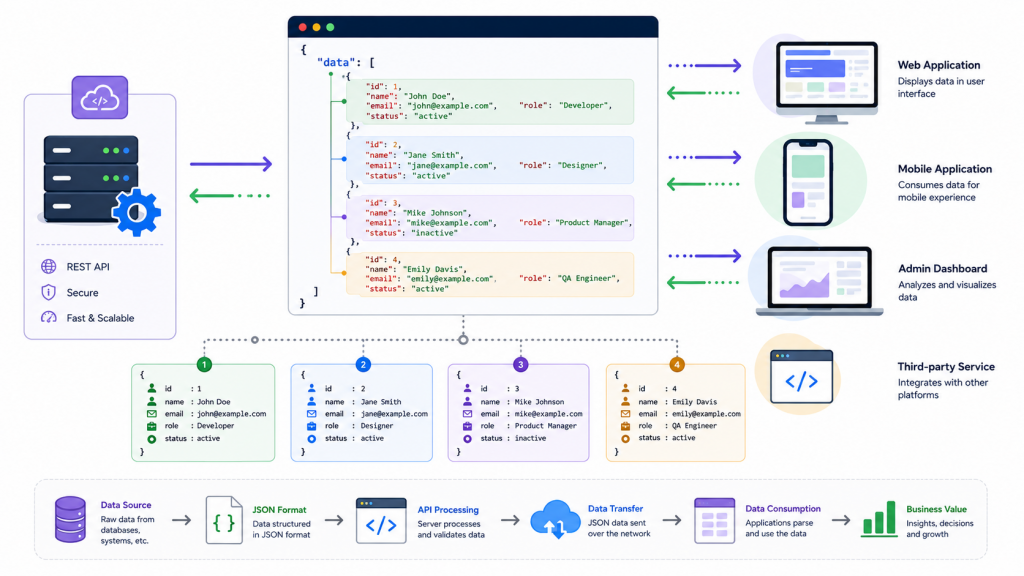
Many applications return user records through arrays.
{
  "users": [
    {
      "name": "Ali"
    },
    {
      "name": "Sara"
    }
  ]
}
Here, JSON syntax square brackets contain multiple user objects within a single collection.
Search Results
Search engines and websites often deliver multiple results through arrays because JSON syntax square brackets provide a simple way to manage grouped data.
Arrays and API Development
Modern APIs rely heavily on arrays. When an application requests information from a server, the response often contains dozens or even thousands of records.
For example, an e-commerce API might return products using JSON syntax square brackets so that applications can display all available items without making separate requests.
This efficient data delivery method improves performance and reduces server load.
As APIs continue to dominate software architecture, understanding JSON syntax square brackets becomes increasingly valuable for developers.
Difference Between Arrays and Objects
Many beginners confuse arrays with objects. While both are important, they serve different purposes.
Arrays use JSON syntax square brackets to store collections of values.
Objects use curly braces to store key-value pairs.
Example of an array:
["Red", "Blue", "Green"]Example of an object:
{
  "color": "Red"
}
Understanding when to use JSON syntax square brackets versus objects is critical for building valid JSON structures.
Nested Arrays and Complex Structures
JSON supports advanced data structures that contain multiple levels of information.
For example:
{
  "scores": [
    [85, 90, 88],
    [78, 82, 80]
  ]
}
In this example, JSON syntax square brackets are used to create arrays within another array.
Nested arrays are useful for:
- Matrices
- Statistical data
- Multi-level records
- Complex application data
They provide flexibility while maintaining a clean structure.
Common Mistakes Developers Make
Even experienced developers occasionally encounter issues when working with arrays.
Missing Commas
Incorrect:
["A" "B"]Correct:
["A", "B"]Unmatched Brackets
Every opening bracket must have a matching closing bracket when using JSON syntax square brackets.
Incorrect formatting can cause parsing errors and application failures.
Trailing Commas
Many programming languages allow trailing commas, but standard JSON does not.
Incorrect:
["A", "B",]Valid JSON requires proper formatting without unnecessary commas.
Incorrect Nesting
When combining arrays and objects, developers must ensure JSON syntax square brackets and curly braces are used correctly.
Proper nesting improves readability and prevents data processing issues.
Best Practices for JSON Arrays
Keep Structures Consistent
Arrays should contain related data whenever possible. Consistency makes information easier to process and maintain.
Validate JSON Frequently
Before deployment, always validate structures that use JSON syntax square brackets. Validation tools quickly identify syntax errors and formatting problems.
Use Descriptive Keys
When arrays are placed inside objects, descriptive property names improve clarity.
Example:
{
  "employeeNames": ["Ahmed", "Usman", "Ayesha"]
}
Avoid Unnecessary Complexity
Although JSON syntax square brackets support nesting, excessive complexity can reduce readability and make maintenance more difficult.
A simple structure is often the most effective solution.
Benefits of Proper Array Usage
Using arrays correctly offers several advantages:
- Better organization
- Improved scalability
- Faster processing
- Easier maintenance
- Cleaner code
- Better API integration
When developers understand JSON syntax square brackets, they can build applications that are more reliable and easier to manage.
This knowledge becomes especially important in large-scale systems where structured data plays a central role.
Real-World Applications
Today, JSON powers countless digital services.
Examples include:
- Social media platforms
- E-commerce websites
- Banking applications
- Cloud platforms
- Mobile apps
- Analytics systems
In each of these environments, JSON syntax square brackets help manage collections of information efficiently.
Whether displaying product inventories or handling customer records, arrays remain a critical component of modern software development.
Organizations that work with large volumes of data depend on JSON syntax square brackets to ensure information remains organized and accessible.
FAQ
What are JSON syntax square brackets used for?
They are used to define arrays and store collections of values within JSON documents.
Can JSON syntax square brackets contain objects?
Yes. Arrays can contain objects, numbers, strings, booleans, and even other arrays.
Why are arrays important in JSON?
Arrays allow developers to manage multiple related values within a single structure.
Can arrays be nested?
Yes. JSON supports nested arrays for handling more complex datasets.
Are arrays commonly used in APIs?
Absolutely. Most modern APIs use arrays to return lists of records and structured information.
Conclusion
JSON remains one of the most widely adopted data formats in the world, and arrays are a core part of its functionality. By understanding JSON syntax square brackets, developers can create cleaner data structures, improve application performance, and simplify data exchange between systems.
From APIs and cloud services to mobile applications and enterprise platforms, JSON syntax square brackets provide an efficient way to organize collections of information. Mastering their use helps developers build scalable, maintainable, and professional software solutions that meet modern development standards.