



























































Science Words: The Ultimate Guide to Powerful, Fascinating, and Confusing Words You Must Know Today

Introduction
Science is everywhere in our lives. From the phone in your hand to the food you eat, everything is connected to scientific ideas. But to understand science better, you need to know the language it uses. That language is built from scientific words that explain complex ideas in simple terms.
In this guide, we will explore science words in a clear and easy way so anyone can understand them, even if you are not a science expert. Some of these words are exciting and useful, while others may feel confusing at first. But once you understand them, science becomes much easier and more interesting.
This article is designed to help students, beginners, and curious readers build strong basic knowledge of scientific language. You will learn meanings, categories, real-life examples, and how these words are used in daily life.
What Are Scientific Words?
These words are special terms used in science to describe ideas, processes, objects, and phenomena. These words help scientists and learners communicate clearly without confusion.
For example:
- “Gravity” explains how objects are pulled toward Earth
- “Atom” describes the smallest unit of matter
- “Energy” explains the ability to do work
Without these words, explaining science would be very difficult.
These words are used in subjects like:
- Physics
- Chemistry
- Biology
- Earth science
- Environmental science
They act like building blocks of scientific understanding.
Why Scientific Terms Are Important
Understanding science words is important for many reasons:
1. Better Learning
When you understand the language of science, you understand the subject faster and more clearly.
2. Clear Communication
Scientists around the world use the same terms. This helps them share ideas without confusion.
3. Real-Life Understanding
science vocabulary help explain everyday things like weather, health, electricity, and technology.
4. Academic Success
Students who learn science vocabulary perform better in exams and assignments.
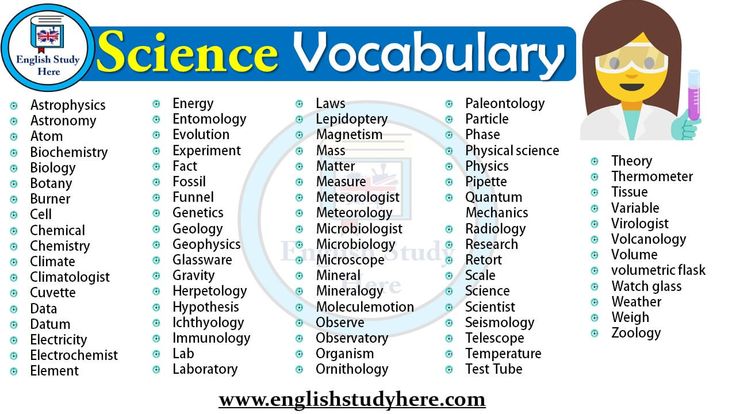
Categories of Scientific Words
Science words can be grouped into different categories based on their subject area.
Biology Science Words
Biology is the study of living things. It includes humans, animals, plants, and microorganisms.
Common Biology Terms
- Cell: Basic unit of life
- DNA: Genetic material that carries instructions
- Organism: Any living thing
- Tissue: Group of similar cells
- Evolution: Gradual change in living things over time
These terms help explain how life works at different levels.
Chemistry Scientific Words
Chemistry studies substances and how they change.
Important Chemistry Terms
- Atom: Smallest unit of matter
- Molecule: Two or more atoms bonded together
- Element: Pure substance like oxygen or gold
- Compound: Combination of elements
- Reaction: Process of changing substances
Chemistry science words explain how materials interact in the world.
Physics Science Words
Physics explains how the universe works, including motion, force, and energy.
Key Physics Terms
- Force: Push or pull on an object
- Energy: Ability to do work
- Motion: Movement of an object
- Gravity: Force that pulls objects toward Earth
- Speed: How fast something moves
These words help explain everything from falling apples to moving planets.
Earth Science Words
Earth science studies the planet we live on.
Important Earth Science Terms
- Atmosphere: Layer of gases around Earth
- Climate: Long-term weather pattern
- Volcano: Opening in Earth that releases lava
- Earthquake: Sudden shaking of Earth
- Erosion: Wearing away of land
These words help us understand natural events and environmental changes.
Environmental Science Words
Environmental science focuses on nature and how humans affect it.
Common Terms
- Pollution: Harmful substances in air, water, or land
- Ecosystem: Community of living things and their environment
- Biodiversity: Variety of life on Earth
- Conservation: Protection of nature
- Renewable energy: Energy from natural sources like sun and wind
These words are important for protecting our planet.
How Science Words Help in Daily Life
Science is not just for scientists. We use science knowledge every day without realizing it.
Example 1: Cooking Food
Heat, temperature, and chemical reactions are all science ideas.
Example 2: Weather Forecast
Words like humidity, pressure, and climate help explain weather reports.
Example 3: Medical Treatment
Doctors use science words like virus, infection, and immunity.
Example 4: Technology
Phones, computers, and the internet all depend on scientific principles.
Difficult Science Words Explained Simply
Some science words may sound complicated, but they are easy when explained well.
Atom
An atom is the smallest part of anything that still keeps its properties.
Gravity
Gravity is the force that pulls everything toward the Earth.
Photosynthesis
Plants use sunlight to make food using this process.
Energy
Energy is what makes things move, grow, or work.
Tips to Learn Science Words Easily
Learning science vocabulary becomes easier with the right methods.
Use Simple Definitions
Start with basic meanings before learning advanced details.
Learn with Examples
Real-life examples make words easier to remember.
Use Visual Learning
Pictures, diagrams, and videos help understanding.
Practice Daily
Review a few new words every day.
Connect with Real Life
Try to connect science words to things around you.
Common Mistakes When Learning Science Words
Many learners struggle with science vocabulary because of simple mistakes.
Mistake 1: Memorizing Without Understanding
Just remembering words is not enough.
Mistake 2: Ignoring Examples
Without examples, meanings can feel unclear.
Mistake 3: Learning Too Many Words at Once
This can cause confusion.
Mistake 4: Not Revising Regularly
Without practice, it is easy to forget.
Science Words in Education
Schools and colleges use science vocabulary in many subjects. Students need to understand these words to:
- Answer exam questions
- Write reports
- Understand textbooks
- Do experiments
Teachers often introduce science words step by step so students can learn easily.
Science Words and Technology
Modern technology depends heavily on science language.
For example:
- Software uses logic and algorithms
- Machines work using force and energy
- Communication uses signals and waves
Without science vocabulary, understanding technology would be very difficult.
Fun Way to Learn Science Words
Learning does not have to be boring.
Try These Ideas:
- Science games
- Flashcards
- Quizzes
- Watching science videos
- Doing simple experiments
These methods make learning fun and memorable.
Future Importance of Science Words
As science grows, new words are created all the time. Future generations will need to learn even more advanced terms related to:
- Space exploration
- Artificial intelligence
- Medical science
- Climate change solutions
Understanding science vocabulary will become even more important in the future.
FAQ Section
What are science words?
Science words are special terms used to explain scientific ideas, processes, and objects.
Why should students learn science words?
They help students understand subjects better, perform well in exams, and improve communication.
Are science words hard to learn?
Not necessarily. With simple explanations and practice, they become easy to understand.
What is the best way to learn science vocabulary?
Using examples, visuals, and daily practice is the most effective method.
Do science words change over time?
Yes, new discoveries often lead to new scientific terms.
Conclusion
Science becomes much easier when you understand its language. Learning science words helps you understand how the world works, from tiny atoms to large galaxies. These words are not just for textbooks but are part of everyday life, technology, health, and nature.
With simple learning methods and regular practice, anyone can master scientific vocabulary and improve their understanding of science step by step.