


























































Artificial intelligence continues to evolve at an incredible pace, with advanced machine learning models and adaptive technologies reshaping industries around the world. Yet amid the excitement surrounding dynamic and self-learning solutions, many organizations still rely on static AI systems to deliver consistent, predictable, and efficient results.
While newer AI approaches often receive most of the attention, static AI systems remain a valuable part of the technology landscape. They provide stability, transparency, and reliability in environments where accuracy and control are more important than continuous adaptation. From customer support workflows to industrial automation, these systems continue to solve practical business challenges every day.
What are static AI systems
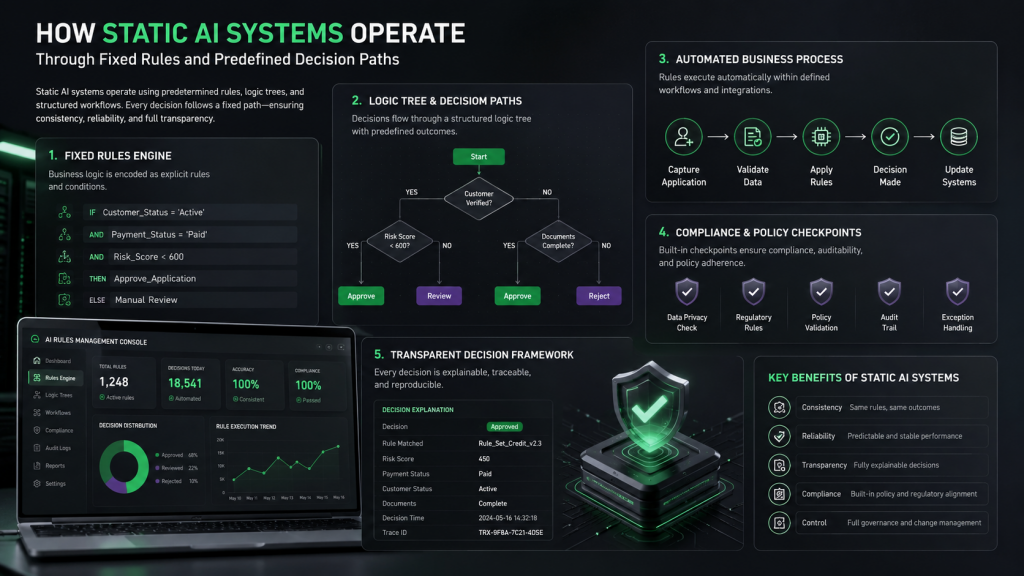
At their core, static AI systems are artificial intelligence solutions that operate using predefined rules, fixed models, or established datasets. Unlike adaptive AI technologies that continuously learn from new information, these systems perform tasks according to programmed instructions and remain unchanged unless manually updated.
Many businesses choose static AI systems because they offer predictable behavior and easier management. Since their decision-making processes remain consistent over time, organizations can test, validate, and deploy them with greater confidence.
Why businesses still use them
The growing popularity of advanced machine learning does not mean every organization needs a constantly evolving solution. In many scenarios, static AI systems provide a more practical and cost-effective option.
Companies operating in highly regulated industries often prefer static AI systems because they make compliance and auditing easier. Decision pathways are generally easier to understand, document, and verify, reducing risks associated with unexpected system behavior.
For organizations that prioritize consistency over adaptability, fixed-model AI can often deliver stronger operational performance than more complex alternatives.
Key characteristics of modern AI solutions
One defining feature of static AI systems is predictability. Because their rules and models remain unchanged during operation, outputs are generally stable and repeatable.
Another advantage of static AI systems is transparency. Stakeholders can more easily understand how decisions are made, making these technologies suitable for applications where accountability and trust are essential.
Common characteristics include:
Rule-based operation
Many systems rely on predefined rules that guide responses and actions.
Fixed knowledge base
The information used by the system remains unchanged until developers introduce updates.
Consistent outputs
The same input typically generates the same output, improving reliability.
Lower maintenance requirements
Compared with continuously learning models, these solutions often require fewer resources to manage.
Real-world applications across industries
Despite the rapid growth of advanced AI, static AI systems continue to play a significant role across multiple sectors.
Customer service automation
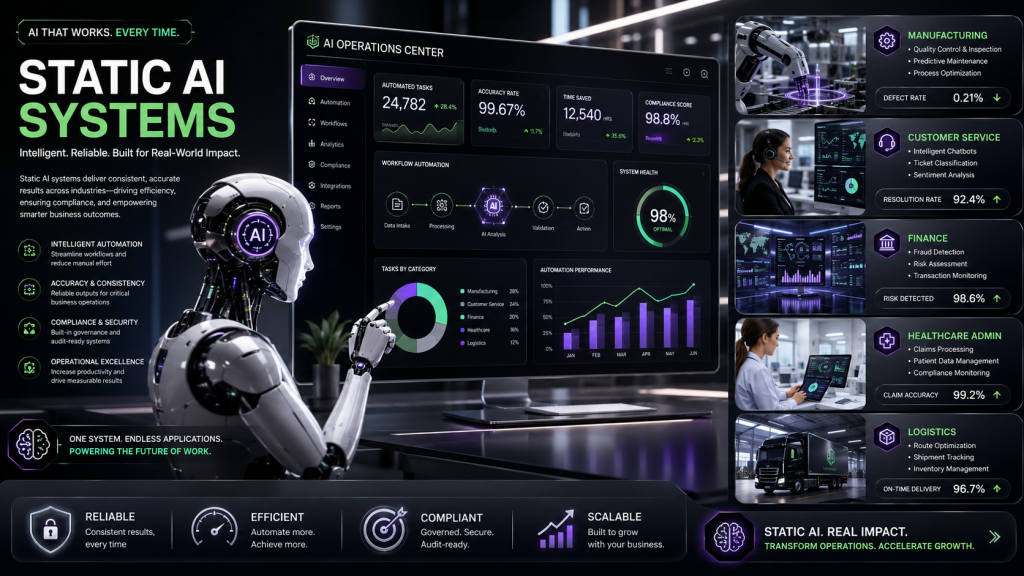
Many organizations use static AI systems to handle common customer inquiries. These tools can answer frequently asked questions, provide product information, and guide users through routine processes without requiring ongoing model retraining.
Manufacturing and industrial operations
Factories often deploy static AI systems for quality control, equipment monitoring, and process management. Their predictable behavior helps maintain operational consistency and minimize disruptions.
Financial and compliance workflows
Financial institutions frequently implement static AI systems for fraud screening, risk assessment, and regulatory checks. Since these applications demand accuracy and accountability, fixed decision frameworks can be highly effective.
Other industries benefiting from this approach include healthcare administration, logistics, education, retail, telecommunications, and government services.
Benefits organizations can expect
Businesses continue to invest in static AI systems because they offer several important advantages.
One major benefit of static AI systems is reliability. Organizations know exactly how the technology will respond under specific conditions, making planning and risk management more straightforward.
Another strength of static AI systems is cost efficiency. Since they typically do not require continuous learning infrastructure, operational expenses can often remain lower than those associated with highly adaptive models.
Additional benefits include:
Faster deployment
Predefined models and rule sets can often be implemented more quickly than complex learning architectures.
Improved compliance
Regulated industries benefit from clear and auditable decision processes.
Easier testing and validation
Organizations can evaluate performance with greater certainty because outputs remain consistent.
Enhanced security
Limited adaptability can reduce exposure to certain types of model manipulation and unexpected behavior.
Limitations to consider
Although they offer valuable advantages, static AI systems are not suitable for every situation.
One limitation of static AI systems is their inability to automatically learn from new data. As environments change, performance may decline unless updates are introduced manually.
Another challenge associated with static AI systems is reduced flexibility. They may struggle when faced with unfamiliar scenarios that fall outside their predefined rules or training data.
Additional drawbacks may include:
- Slower adaptation to market changes
- Dependence on manual updates
- Limited personalization capabilities
- Reduced effectiveness in highly dynamic environments
Understanding these limitations helps organizations determine whether a fixed or adaptive approach is the better choice for a specific use case.
Static versus adaptive AI
Choosing between static AI systems and adaptive technologies depends largely on business objectives.
In many cases, static AI systems perform exceptionally well when consistency, transparency, and compliance are top priorities. Organizations that require stable decision-making often find these solutions more practical than constantly evolving models.
By contrast, adaptive systems excel in environments where data changes frequently and continuous learning creates measurable value. Examples include recommendation engines, advanced personalization platforms, and predictive analytics applications.
Decision-makers should evaluate factors such as operational complexity, regulatory requirements, maintenance costs, scalability goals, and long-term business strategy before selecting an AI framework.
Best practices for successful implementation
Organizations seeking maximum value from AI should follow several proven practices:
Define clear objectives
Identify the exact business problem the technology is expected to solve.
Use high-quality data
Accurate and relevant data improves system effectiveness and reliability.
Conduct regular reviews
Even fixed solutions should be evaluated periodically to ensure continued relevance.
Maintain documentation
Comprehensive records support compliance, troubleshooting, and future updates.
Monitor performance metrics
Tracking key indicators helps organizations identify opportunities for improvement.
By following these principles, businesses can maximize return on investment while minimizing operational risks.
The future of AI technology
As artificial intelligence continues to evolve, static AI systems will likely remain an important part of enterprise technology strategies. While adaptive AI attracts significant attention, many organizations still require solutions that prioritize control, reliability, and predictable performance.
Future developments may combine fixed decision frameworks with selective automation features, creating hybrid models that balance stability and innovation. This approach could allow businesses to maintain governance standards while benefiting from targeted improvements in efficiency and accuracy.
Frequently Asked Questions
What is the main difference between static and adaptive AI?
Static AI operates using fixed rules or models, while adaptive AI can learn from new data and modify its behavior over time.
Are fixed AI solutions still relevant today?
Yes. Many industries rely on predictable and transparent AI technologies for compliance, quality control, customer service, and operational management.
Which industries benefit most from fixed-model AI?
Finance, healthcare administration, manufacturing, logistics, education, telecommunications, retail, and government agencies commonly use these solutions.
Are these systems easier to manage?
In many cases, yes. They generally require less ongoing maintenance and fewer computational resources than continuously learning systems.
Can fixed AI solutions be updated?
Yes. Developers can modify rules, datasets, or models when business requirements change.
Conclusion
The rapid advancement of artificial intelligence has introduced powerful new capabilities, but static AI systems continue to provide meaningful value across industries. Their reliability, transparency, cost efficiency, and predictable performance make them an attractive choice for organizations that prioritize stability and control. By understanding both the strengths and limitations of this technology, businesses can make smarter decisions and implement AI solutions that align with their operational goals.