




















































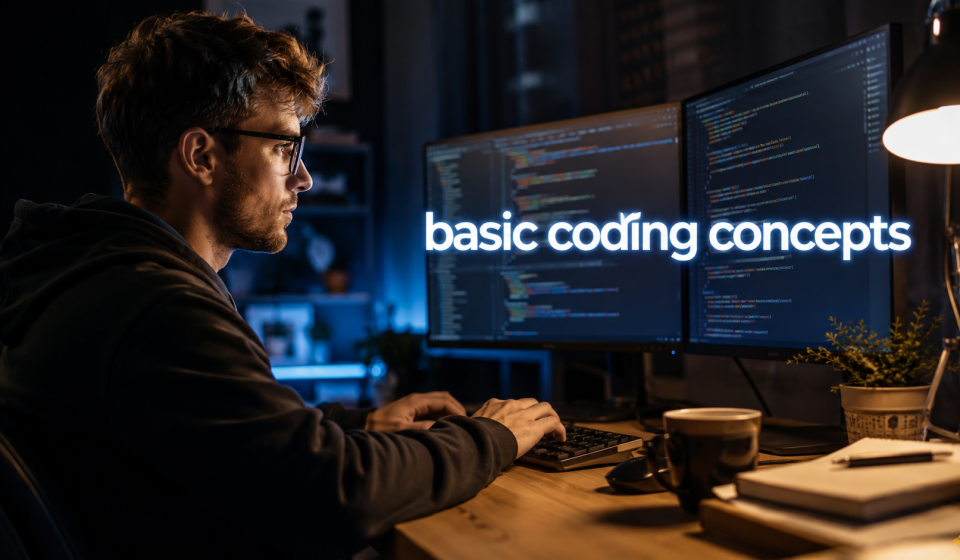

Technology touches almost every part of modern life. From mobile apps and websites to smart devices and artificial intelligence, software powers the digital world. Yet many beginners feel overwhelmed when they start learning programming because they assume coding is complicated.
The truth is that understanding basic coding concepts can make the learning journey far easier and more enjoyable. Instead of memorizing syntax, successful programmers first focus on understanding the principles that drive software development.
Whether you want to become a software developer, build your own projects, or simply understand how applications work, mastering basic coding concepts gives you a strong foundation that applies to almost every programming language.
What Are basic coding concepts?
In simple terms, basic coding concepts are the fundamental principles that explain how computer programs function. They include ideas like variables, conditions, loops, functions, and data structures.
These concepts are considered universal because they appear in nearly every programming language. Learning basic coding concepts first allows beginners to switch between languages such as Python, JavaScript, Java, and C++ more easily.
According to various developer surveys, programmers who understand core principles rather than memorizing code snippets often learn new technologies significantly faster and solve problems more efficiently.
Why Every Beginner Should Learn basic coding concepts First
Many new programmers jump directly into frameworks and tools without understanding the fundamentals. This often leads to confusion and frustration.
By focusing on basic coding concepts first, learners develop problem-solving skills, logical thinking, and confidence. Instead of depending on tutorials for every step, they can analyze problems independently and create better solutions.
Variables and Data Types
One of the most important basic coding concepts is understanding variables and data types.
A variable acts like a container that stores information. For example:
- Name = “John”
- Age = 25
- Price = 99.99
Data types define what kind of information a variable can hold. Common examples include:
- Strings for text
- Integers for whole numbers
- Floating-point values for decimals
- Boolean values for true or false conditions
Without understanding variables and data types, writing meaningful programs becomes extremely difficult.
Control Flow and Decision-Making
Another essential part of basic coding concepts is control flow.
Programs make decisions using conditional statements such as:
- If
- Else
- Else if
- Switch statements
Imagine an e-commerce website. If the payment succeeds, the system confirms the order. Otherwise, it displays an error message.
Understanding basic coding concepts related to decision-making allows developers to create dynamic and interactive applications rather than static pages.
Loops and Repetition
Among all basic coding concepts, loops are particularly powerful because they automate repetitive tasks.
Suppose you need to send notifications to one thousand users. Writing the same instruction repeatedly would be inefficient. Instead, loops execute the task automatically.
Popular loop types include:
For Loop
Used when the number of repetitions is known.
While Loop
Runs until a specific condition changes.
Do-While Loop
Executes at least once before checking the condition.
Developers who understand basic coding concepts involving loops can write shorter, cleaner, and more efficient code.

Functions and Code Reusability
Functions are another pillar of basic coding concepts.
A function is a reusable block of code designed to perform a specific task. For example, an online store may have separate functions for:
- User authentication
- Payment processing
- Order confirmation
- Email notifications
Using functions provides several advantages:
- Better organization
- Easier debugging
- Improved readability
- Reduced duplication
- Faster development
Modern software applications often contain hundreds or even thousands of functions working together.
| Author Bio | Details |
|---|---|
| Name | Naveed Khatri |
| Profession | Technology Writer, Cybersecurity Researcher, and AI Enthusiast |
| Website | https://moderntrendsnow.com/ |
| Expertise | Cybersecurity, Emerging Technologies, Artificial Intelligence (AI), Digital Innovation |
| Social Profiles | LinkedIn, Medium, Reddit |
Data Structures and Algorithms
An important stage in learning basic coding concepts is understanding data structures and algorithms.
Data structures organize information efficiently. Common examples include:
- Arrays
- Lists
- Stacks
- Queues
- Dictionaries
- Trees
Algorithms are step-by-step instructions used to solve problems.
For instance, search engines rely on advanced algorithms to deliver results in milliseconds. Social media platforms use algorithms to personalize feeds and recommend content.
Learning basic coding concepts in this area significantly improves problem-solving abilities and prepares programmers for technical interviews and real-world software development.
Debugging and Problem Solving
Many people think expert programmers write perfect code immediately. In reality, debugging is a major part of software development.
One of the practical basic coding concepts every beginner should embrace is systematic problem solving.
Effective debugging techniques include:
- Reading error messages carefully.
- Breaking problems into smaller components.
- Testing one change at a time.
- Using debugging tools.
- Reviewing assumptions.
Experienced developers often spend more time understanding problems than writing code. This analytical mindset separates effective programmers from those who struggle with complex projects.
Why These Fundamentals Matter Across Programming Languages
Technology changes rapidly. Programming languages, frameworks, and development tools continuously evolve.
However, the underlying principles remain largely the same.
Someone who understands basic coding concepts can transition from Python to JavaScript or from Java to Go with far less difficulty. The syntax may change, but the logic behind variables, loops, functions, and algorithms remains familiar.
This adaptability makes foundational knowledge one of the most valuable investments for anyone entering the technology industry.
Practical Tips for Learning Faster
Understanding theory is important, but practical experience accelerates learning.
Here are several strategies that work well:
- Practice coding every day, even for twenty minutes.
- Build small projects like calculators and to-do applications.
- Read other developers’ code.
- Join programming communities.
- Solve beginner-friendly coding challenges.
- Keep notes of new ideas and techniques.
Consistent practice reinforces concepts and helps transform abstract ideas into practical skills.
Common Mistakes Beginners Should Avoid
New programmers frequently make avoidable mistakes, including:
- Trying to learn multiple languages simultaneously
- Copying code without understanding it
- Ignoring error messages
- Avoiding projects because they seem difficult
- Memorizing syntax instead of learning logic
The most successful learners focus on gradual progress and continuous experimentation. Programming is a skill developed through repeated practice rather than passive reading.
Recent Post
- Why Robotics Programming Is Becoming the Skill Everyone Wants
- Why ABT Electronics Continues to Win Customer Trust
- Why Hardware Still Drives the Digital World
- Why Refixs2.5.8a Is Creating Buzz Among Digital Users
- Literary Devices: How to Use Creative Writing Secrets for Great Tech Blogs
Frequently Asked Questions
What are basic coding concepts?
basic coding concepts are the fundamental principles that explain how software works, including variables, loops, conditions, functions, and data structures.
Why are basic coding concepts important?
Understanding basic coding concepts helps programmers think logically, solve problems efficiently, and learn new programming languages more quickly.
Which programming language is best for beginners?
Python is often recommended because its syntax is simple and easy to read. However, JavaScript is also an excellent choice, especially for web development.
How long does it take to learn coding fundamentals?
Most beginners can understand core principles within a few weeks of consistent practice. Building confidence and practical experience usually takes several months.
Do I need a computer science degree to learn programming?
No. Many successful developers are self-taught and have built careers through online courses, practice projects, and continuous learning.
Conclusion
Every successful programmer starts with the same foundation. Understanding basic coding concepts provides the knowledge needed to think logically, write efficient code, and adapt to new technologies. Instead of rushing toward advanced tools and frameworks, invest time in mastering the fundamentals first. The stronger your foundation becomes, the easier it will be to build applications, solve real-world problems, and grow into a confident developer.